Magnesium has become a nightly ritual for millions.
A capsule before bed.
A powder stirred into water.
A promise of calm.
It is taken for sleep, for cramps, for restless legs, for anxiety, for muscle recovery. It sits in medicine cabinets beside vitamin D and fish oil, quietly indispensable.
The global magnesium supplement market is worth billions. New formulations appear each year. “Enhanced absorption.” “Advanced bioavailability.” “Next-generation chelation.”
And yet, deficiency persists.
Nearly every practitioner hears the same refrain:
“I take magnesium… but I still get cramps.”
If magnesium is one of the most widely consumed minerals in the developed world, why does the problem refuse to disappear?
The answer may have less to do with dosage — and more to do with how we arrived here.
From Rock to Capsule
Most magnesium supplements do not begin in a lab.
They begin in stone.
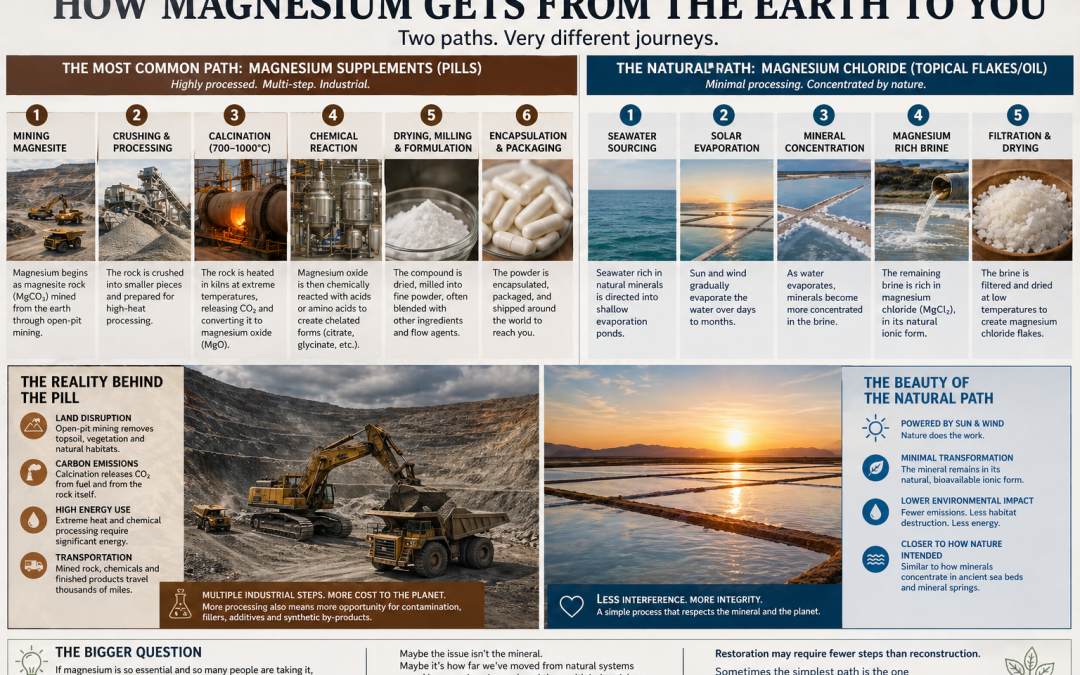
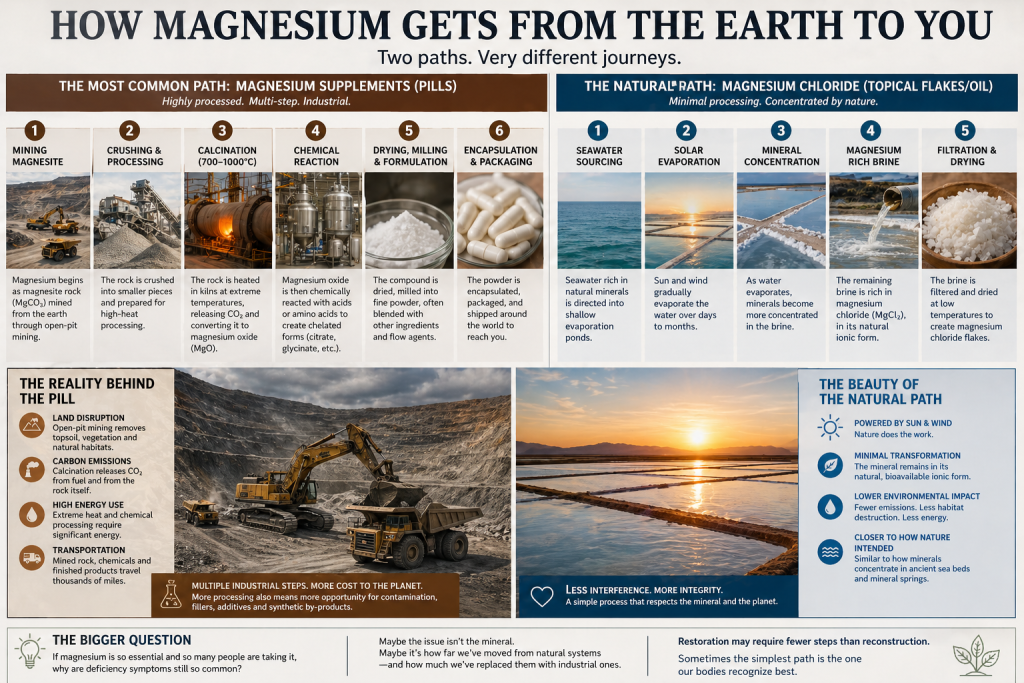
Magnesite — magnesium carbonate — is mined, often through open-pit extraction. Land is cleared. Rock is blasted. Heavy equipment hauls ore into processing plants.
There, the mineral is crushed and heated to temperatures approaching 1,000 degrees Celsius in a process called calcination. Carbon dioxide is driven off, and magnesium oxide remains.
MgCO₃ becomes MgO.
It is a permanent structural transformation.
Energy is consumed. Carbon dioxide is released — both from fuel and from the mineral itself.
Magnesium oxide is not sinister. It is chemically straightforward. But it is industrially remade.
From there, many supplements travel further.
To produce magnesium citrate, glycinate, malate, or other chelated forms, magnesium oxide or hydroxide is reacted with organic acids or amino acids. The reaction is controlled. The compound is dried, milled, encapsulated, stabilized, packaged, shipped.
Each step adds refinement — and distance.
By the time the mineral reaches a capsule, it has passed through multiple phases of extraction, heating, reaction, and manufacturing.
It is no longer simply found.
It is constructed.
The Ocean Alternative
Magnesium chloride follows a different path.
In seawater, magnesium already exists in ionic form — dissolved, suspended, part of a vast mineral system that predates industry.
To harvest magnesium chloride from brine, seawater is directed into evaporation ponds. Sun and wind remove water slowly. Salts crystallize in stages. A magnesium-rich brine remains, which is concentrated and dried.
No calcination.
No carbonate destruction.
No 1,000-degree kiln.
The mineral is not chemically redesigned. It is concentrated.
This does not make brine operations impact-free. Evaporation ponds alter landscapes. Industrial scale is still industrial scale.
But structurally, the mineral remains closer to its geological state.
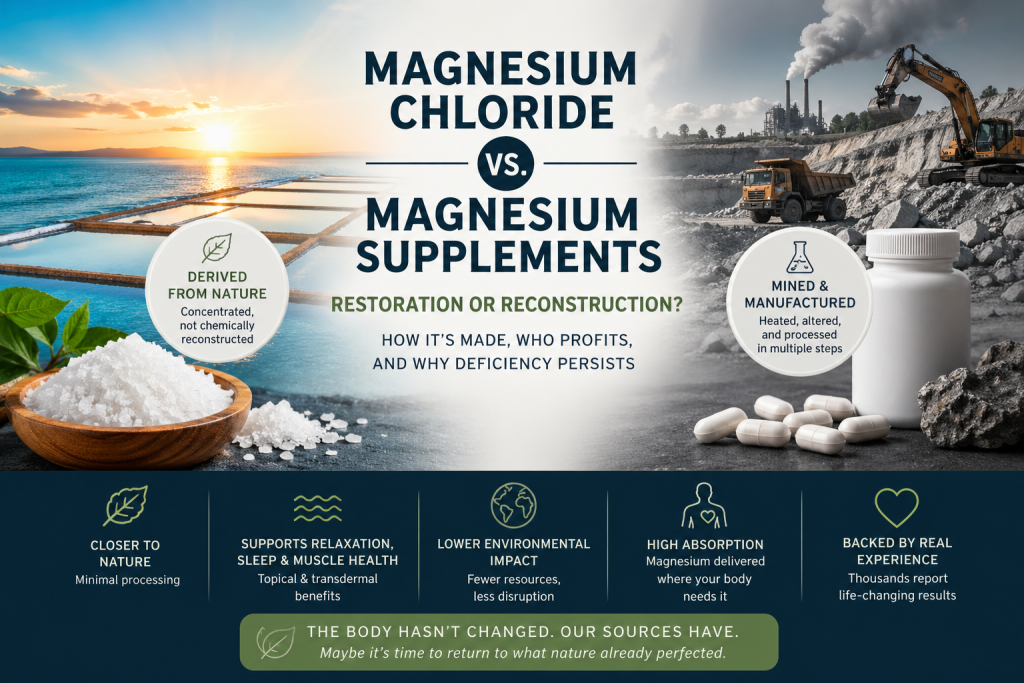
One path reconstructs.
The other condenses.
The Industry Paradox
The magnesium supplement market continues to expand.
Magnesium is recommended for stress — and stress is ubiquitous. It is suggested for muscle cramps — and cramps are common. It is promoted for sleep — and sleep disorders are rising.
If millions are supplementing daily, arithmetic alone suggests deficiency should decline.
Yet anecdotal complaints remain stubbornly consistent.
This does not indict supplementation.
But it does suggest something larger.
Magnesium deficiency is not merely a personal failure to take the right capsule. It reflects:
• Soil depletion from industrial agriculture
• Mineral stripping through water treatment
• Monocropping and nutrient imbalance
• Chronic physiological stress, which increases magnesium demand
• Diets increasingly divorced from mineral density
In other words, we are attempting to solve an ecological deficit with a retail solution.
Upstream repair — restoring mineral-rich soil and water — is slow and systemic.
Downstream supplementation is scalable and profitable.
The tension between those two approaches shapes the market more than most consumers realize.
Restoration or Reconstruction?
All magnesium, once absorbed, becomes Mg²⁺.
The ion is identical.
But the journey differs.
Blasting.
Kilns.
Reactors.
Encapsulation lines.
Versus:
Sun.
Wind.
Evaporation.
The difference is not molecular in the bloodstream.
It is philosophical — and environmental.
In a century defined by industrial solutions, we have grown accustomed to reconstruction.
We mine what was once whole.
We burn it.
We rebuild it.
We package it.
And then we wonder why the deficit persists.
The Transdermal Revival
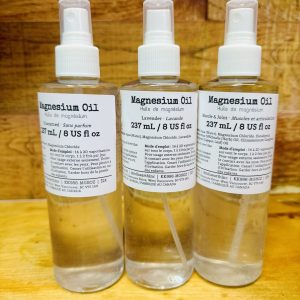
In recent decades, a quieter conversation has emerged around topical magnesium chloride — bathing, soaking, applying directly to skin.
Books such as The Magnesium Miracle by Dr. Carolyn Dean and Transdermal Magnesium Therapy by Dr. Mark Sircus have explored this approach. Clinical data remains limited and debated, but experiential reporting is consistent: deep relaxation, muscle release, improved sleep.
For many, immersion in mineral-rich water feels fundamentally different from swallowing a capsule.
Perhaps that is not surprising.
For most of human history, magnesium exposure occurred environmentally — through mineral springs, coastal living, and groundwater.
The body evolved in contact with minerals, not packaging.
The Question of Scale
There is one more layer to this story.
I began working with magnesium chloride as a one-person operation.
No corporate sponsorship.
No advertising budget.
No distribution network.
When I started, magnesium chloride products were difficult to find locally. It was not a trend.
I spoke in small rooms. On radio. On podcasts. One conversation at a time.
People returned.
Not with vague testimonials — but with specific patterns:
“My restless legs stopped.”
“My sleep changed.”
“My neck released.”
“My cramps disappeared.”
If this were mere suggestion, it would have faded.
Instead, more producers entered the space. Retail shelves filled. Eventually, online marketplaces carried products that did not exist locally when I began.
That is how diffusion works.
Not through corporate campaigns.
Through repeated, independent experience.
Human experience is imperfect data — but when it accumulates across geography and demographics, it is not noise.
It is signal.
The Larger Question
If a small, unfunded operation can catalyze this much organic demand, what does that reveal?
Not about marketing.
About need.
Perhaps magnesium is not failing.
Perhaps we are.
Perhaps the issue is not which chelate is superior, but how far modern life has drifted from mineral contact altogether.
We have filtered the water.
Stripped the soil.
Accelerated the pace of living.
And then engineered a solution to replace what we removed.
Magnesium capsules are not villains.
But they may be downstream answers to upstream losses.
The question is not whether supplements work.
The question is whether reconstruction can ever fully substitute for restoration.
And that is a conversation far larger than a pill.
Related Reading
- THE PIGS KNEW FIRST.
- The Carpenter Who Was Told He Needed Spinal Fusion — And Why It Never Happened
- Mila Earth: Magnesium Body Care That Works Like Mineral Therapy