Just one New Year’s resolution!
If Seed Oils Were Invented Today, Here’s What Would Happen
Let’s try a thought experiment.
Imagine it’s 2026 and someone submits a proposal to a modern food standards committee.
“I’ve created a new cooking oil.”
The panel looks interested.
“Alright,” they say.�“Tell us how it’s made.”
The Proposal
“It comes from industrial seeds — corn, canola, soy, sunflower.”
“Okay.”
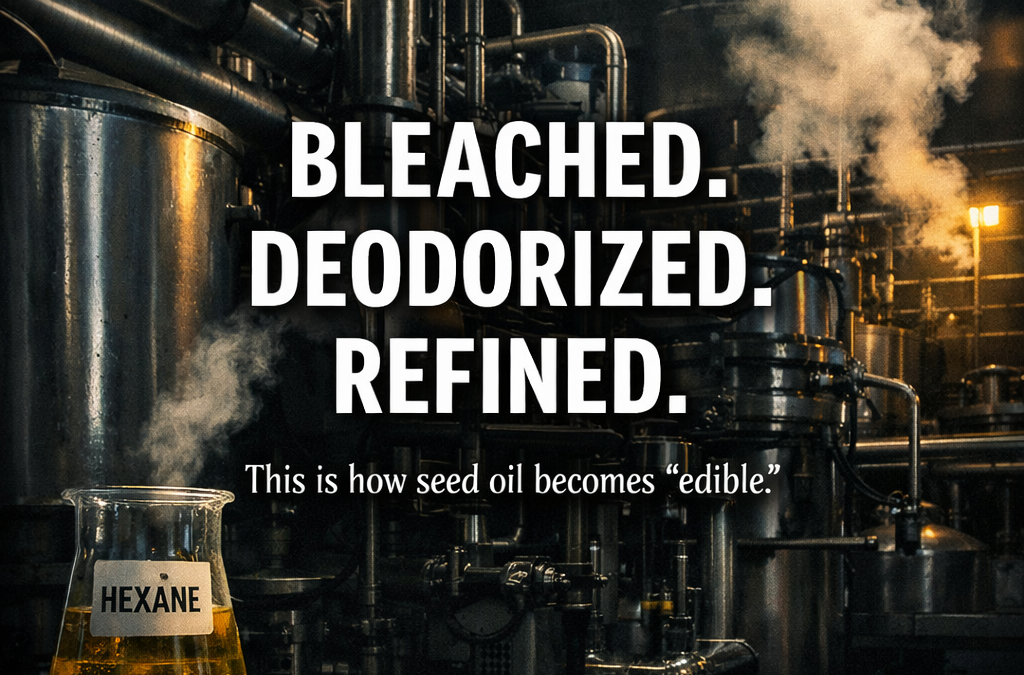
“We extract the oil using a petroleum-based solvent called hexane. Then we apply high heat, bleach it to remove colour, and deodorise it to remove odour.”
The room goes quiet.
Someone asks the obvious question:
“Why not just press it… like olive oil?”
The Catch
The inventor hesitates.
“We can’t. These seeds weren’t designed to yield oil naturally. They’re unstable. We need chemical solvents and high heat to make the oil usable.”
A pause.
“And the side effects?”
The Details Most Labels Don’t Share
“Well,” the inventor says carefully,�“the oil oxidises easily, especially when heated. Oxidised fats produce inflammatory byproducts.”
The panel flips through supporting data.
“There are associations in observational research with insulin resistance, metabolic dysfunction, cardiovascular disease markers, and chronic inflammation.”
A beat.
“But it’s inexpensive.”
Nutritional Value?
“What does it offer nutritionally?”
“Calories. Very little micronutrient value. It’s extremely high in omega-6 linoleic acid — far beyond what humans historically consumed.”
Someone notes that omega-6 dominance can drive inflammatory signalling when not balanced.
“But it’s shelf-stable,” the inventor adds.
Long-Term Impact?
“What happens with regular use?”
“Oxidative stress. Cell membrane disruption. Mitochondrial strain. Systemic inflammation. Some people report brain fog or joint pain.”
Silence.
“But the margins are excellent.”
Where Would This Oil Be Used?
“Everywhere,” the inventor says.
Cooking. Frying. Baking. Restaurants. Fast food. Ultra-processed foods.�Nearly everything in the modern supermarket.
“And would this pass modern food approval standards today?”
The inventor exhales.
“It would face serious scrutiny under current safety and processing frameworks.”
So Why Did It Win?
“Because it’s cheaper than butter, tallow, or olive oil. It lasts longer. And it’s profitable at scale.”
A regulator asks,
“What about traditional fats?”
“Oh, we’ll demonise them,” the inventor shrugs.�“Call saturated fat dangerous. Even though humans consumed it for thousands of years.”
“And olive oil or avocado oil?”
“We’ll price them higher and market the industrial oil as heart healthy instead.”
The Verdict
“If this product were introduced today?”�the panel asks.
“It wouldn’t be waved through the way it was in the mid-20th century.”
And that’s the part most people miss.
Why Seed Oils Are Everywhere
Seed oils dominate our food system not because they’re ideal, but because they were already established before food science matured.
They were normalised when:
- Chronic disease rates were low
- Ultra-processed food was uncommon
- Long-term metabolic effects weren’t well understood
Today, we know more.
Highly processed omega-6 oils oxidise easily under heat.�Oxidised fats damage cell membranes.�Chronic, low-grade inflammation is a shared pathway in many modern metabolic diseases.
What the Newer Science Is Also Showing
Here’s an important piece that often gets overlooked.
Recent large population studies have found that higher levels of HDL (“good” cholesterol) are associated with longer life and lower all-cause mortality.
That matters because:
- HDL supports cellular repair and immune balance
- It helps transport fats away from arterial walls
- It reflects a metabolic environment supported by nutrient-dense, traditional fats
This challenges the idea that all fats should be feared — and reinforces that fat quality matters.
This Isn’t About Fear — It’s About Access
This isn’t about telling people they’re doing something wrong.
It’s about access to information.
Most people were never told:
- how seed oils are made
- why they require refining
- how they differ from traditional fats
They were simply told they were “healthy.”
Everyone deserves to understand what’s in their food — without shame, without gatekeeping, without needing a nutrition degree.
So What Are the Alternatives?
Fats humans have used across cultures for generations:
- Butter
- Ghee
- Tallow
- Olive oil
- Avocado oil
- Coconut oil
Not because they’re trendy — but because they’re stable, nutrient-dense, and familiar to human biology.
The Takeaway
If seed oils were invented today, they would not be waved through unquestioned.
They weren’t invented today.�They were normalised decades ago.
Now we know more.
And knowledge should be accessible — not reserved for insiders.
Save this for the next time someone says seed oils are fine just because they’re everywhere.
SeedOilAwareness
SeedOilFree
IngredientTransparency
FoodEducation
FoodLiteracy
KnowYourIngredients
ReadTheLabel
UltraProcessedFoods
IndustrialFood
FoodProcessing
RefinedOils
ChemicalExtraction
RealFood
WholeFoodLiving
TraditionalFats
HealthyFats
AncestralNutrition
LowToxLiving
CleanEating
HolisticHealth
WellnessEducation
InflammationAwareness
MetabolicHealth
ConsciousConsumer
FoodScience
HealthAwareness
WellnessCommunity
IngredientsMatter
MilaEarth
MilaEarthBodycare

Related Reading
- THE PIGS KNEW FIRST.
- Magnesium Chloride vs Supplements: How It’s Made, Who Profits — and Why Deficiency Persists
- Fresh Matters: Why Mila Earth Products Don’t Last Forever