Why I am writing about DMSO
At almost every market, someone asks me about DMSO. Some people swear by it, and others have heard it is dangerous. So I would like to share what I have learned, clearly and honestly, with the research right beside it.
I have worked with minerals and plants for over 20 years, and DMSO is one of the most fascinating ingredient stories I know. However, it is also one of the most misunderstood, and it deserves real respect.
To be clear from the start: Mila Earth products are made without DMSO, because Health Canada does not allow it in cosmetics. This article is here to help you understand it and make your own informed choice.
Where DMSO comes from
DMSO (dimethyl sulfoxide) was first made in 1867 by the Russian chemist Alexander Zaytsev (McGill Office for Science and Society). Today it is made mainly as a by-product of turning wood into paper (WebMD).
For decades it was simply a very good industrial solvent. Then, in the early 1960s, the chemist Robert Herschler and the Oregon surgeon Dr. Stanley Jacob began studying what it did in the body. Newspaper stories in 1963 created a huge wave of excitement (McGill).
In 1965, the US FDA halted human research after changes to the lens of the eye were seen in laboratory animals (McGill; dermatology review). Those eye changes have not been seen in people, but DMSO never fully recovered its reputation. That history explains a lot about how it is sold today.
How DMSO works: the science
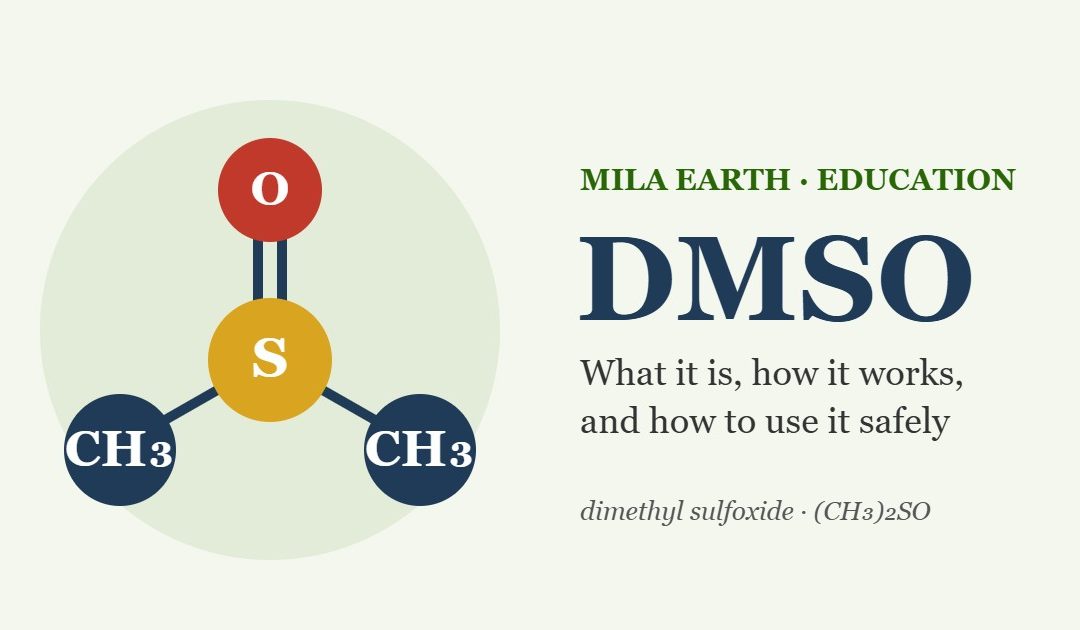
DMSO is a tiny molecule that mixes with both water and oils. That rare combination is what makes it such a powerful solvent, and it is also the key to how it behaves on skin (Wikipedia).
Your skin’s outer layer, the stratum corneum, is built like a brick wall: skin cells are the bricks and a mortar of fats called ceramides holds them together. A 2026 scientific review describes three things DMSO does to that wall (Albayati et al., 2026):
- It loosens the mortar. DMSO disrupts how the ceramides are arranged, making the barrier more fluid and easier to pass through.
- It changes the shape of skin proteins, including keratin, which weakens the barrier further.
- It displaces water in the skin, which helps other molecules move through.
Computer simulations of cell membranes help explain why. DMSO slips in among the fatty molecules, thins the layer and can open tiny water-filled pores; at very high strength it can break the layer apart (Notman et al., 2006).
The stronger the DMSO, the stronger the effect (Albayati et al.). Once through the skin, it travels around the body, and it is broken down into compounds that give many people a garlic or oyster taste and a smell on the breath and skin for up to 72 hours (Rimso-50 product monograph).
Why it is called a carrier
DMSO does not only pass through the skin itself. It also carries other molecules with it. That is why pharmaceutical companies use it: an approved prescription pain gel, Pennsaid, uses 45.5% DMSO as the base that carries its medicine into the skin (Pennsaid prescribing information).
It is also why DMSO has to be handled with so much care. It cannot tell the difference between the good and the bad. Whatever is on your skin, your hands or your container can travel in with it.
How DMSO is used today
- As a solvent in laboratories and industry, which is still its main use (Science Feedback).
- In medicine, to freeze living cells. DMSO protects cells from ice damage, and it is still the standard protectant for freezing the stem cells used in transplants (Bone Marrow Transplantation, 2021).
- As a carrier in approved medicines, such as the Pennsaid gel above.
- In veterinary care. A DMSO product called Domoso is approved to reduce acute swelling from injury in dogs and horses (Domoso label). hmmmm and pause!
- As a prescription treatment for one bladder condition, explained next.
The bladder condition DMSO is prescribed for
DMSO’s one approved use in people is for interstitial cystitis, a long-lasting and painful bladder condition also called bladder pain syndrome. In 1978, the FDA approved a 50% DMSO solution called Rimso-50 for it (Capriotti & Capriotti, 2012).
In Canada, Rimso-50 has a Health Canada product monograph for the “symptomatic relief of patients with interstitial cystitis” (Rimso-50 monograph). In a small controlled trial of 33 people with interstitial cystitis, 53% of those treated with DMSO were markedly improved, compared with 18% on a salt-water placebo (Perez-Marrero et al., 1988). It is not rubbed on the skin. A doctor places it directly into the bladder through a catheter and repeats the treatment on a schedule. The monograph also recommends eye exams before and during treatment, as a precaution.
What the research says about DMSO on the skin
Many people use DMSO on sore spots at home, so here is what the studies actually found:
| Topic | Study | What it found |
|---|---|---|
| Knee osteoarthritis | Simon et al., 2009, 775 people | DMSO on its own worked no better than a placebo. A medicine carried in DMSO did work better than placebo. |
| Joint discomfort (osteoarthritis) | Brien et al., 2008 review, 6 studies | No definitive evidence for DMSO or MSM. The studies were small, short and of mixed quality. |
| Complex regional pain syndrome | Zuurmond et al., 1996, 32 people | A 50% DMSO cream showed some benefit compared with placebo. |
| Complex regional pain syndrome | Perez et al., 2003, 146 people | DMSO cream and an oral medicine worked about equally. There was no placebo group. |
| Pain and inflammation in general | Memorial Sloan Kettering | A few studies show benefits on the skin, but more studies are needed. |
So the honest picture is this. DMSO is a proven carrier, and many people love how it feels. However, the studies of DMSO on its own are few, small and mostly decades old, and the evidence is best described as promising, not proven. Please be wary of anyone online who calls it a cure for serious illness (Science Feedback; Memorial Sloan Kettering).
Why DMSO is sold as a solvent
In Canada, DMSO is treated as a drug. Health Canada’s Cosmetic Ingredient Hotlist lists it as prohibited in cosmetics (current Hotlist; 2018 copy), and the only DMSO product approved for people is the prescription bladder treatment.
That means no one can legally sell DMSO in Canada as a cream, a remedy or a body-care product. What you can buy online is sold as a chemical solvent, often labelled for laboratory or industrial use. It is legal to buy that way, but it also means there is no one checking what is in the bottle. That is why choosing a pure, pharmaceutical grade matters so much.
It is also why you will not find DMSO in Mila Earth products or in any compliant body care sold in Canada.
Be careful: it carries whatever it touches
This is the most important part of this article. Because DMSO carries other molecules through the skin, it will “cause anything on the skin to be absorbed” (WebMD). Even the veterinary product label tells users to wear protective gloves, and to wait until it is fully dry before putting any other product on the same area (Domoso label).
So think about everything DMSO will meet:
- Your skin: lotion, perfume, sunscreen, soap residue, garden soil.
- Your hands, if you apply it without gloves.
- Anything you mix it with, including synthetic fragrance or ingredients you cannot name.
- Your container. DMSO can soften some plastics, so plastic can end up in the mix (Origen).
- Your medications. It can increase how much of a medicine on the same skin is absorbed (WebMD).
Only let DMSO meet clean, simple ingredients you would be happy to have inside your body.
Side effects and who should avoid it
- A garlic or oyster taste, bad breath, and dry, red or itchy skin are common (Memorial Sloan Kettering).
- Allergic-type reactions are possible, because DMSO can release histamine in the skin (Rimso-50 monograph).
- Eye changes have been seen in animals given DMSO long term, but not in people followed during bladder treatment (Rimso-50 monograph).
- Please do not use DMSO if you are pregnant or breastfeeding (WebMD). If you take any medication or have a health condition, talk to your doctor or pharmacist first.
If you choose to use DMSO at home
People who use DMSO at home generally follow these habits:
- Wash and dry the skin first, and wash your hands or wear gloves.
- Patch test a small spot and wait a day.
- Dilute it. Full-strength DMSO is more likely to irritate, so it is usually diluted with distilled water.
- Only mix it with things you would be happy to have absorbed.
- Use glass and clean tools, and store it closed, cool and away from light.
- Keep it away from children, pets and eyes.
I am not giving amounts, and I am not recommending DMSO for any condition. If you have a health concern, please talk to a doctor, naturopathic doctor or pharmacist who knows DMSO.
How to choose good-quality DMSO
- Look for pharmaceutical grade, ideally labelled USP or Ph. Eur. A “99.9%” label is not enough on its own, because industrial grade can also be 99.9% (technical grade sheet). Pharmaceutical grade is made to drug-manufacturing standards (Gaylord Chemical).
- Ask the seller for a certificate of analysis (COA) for your batch.
- Choose glass bottles over plastic.
- A strong, unpleasant smell straight from the bottle can point to impurities (Pharmaceutical Technology).
- Do not worry if it turns solid in a cool room. DMSO freezes at about 18.5 °C and melts again at room temperature (Wikipedia).
Katerina’s Finds: what I choose for my own home
These are the products I would choose for my own family. I cannot sell them to you, but I can absolutely point you to the good stuff.
The DMSO I recommend
NeuRxal DMSO 99.9%, 120 ml with dropper
USP pharmaceutical grade in a glass bottle with a precision dropper, which makes it easy to measure and keep clean.
See it on Amazon.caDMSO 99.9% Pharma Grade, 8 oz
The larger glass bottle, for people who use it more often.
See it on Amazon.caWhichever DMSO you choose, ask the seller for a certificate of analysis for your batch.
A book to go deeper
This book shares its author’s own views and experience, which go further than the research I have cited above.
Healing with DMSO & Methylene Blue, by Michael A. Peterson
A book on how people use DMSO at home.
See the bookYou can find more of the things I love on Katerina’s Finds.
As an Amazon Associate I earn from qualifying purchases. I only recommend what I would choose for my own family.
This article is for education only. It is not medical advice, and it does not diagnose, treat or prevent any condition. Please talk to a qualified health professional before using DMSO.
Sources
- Capriotti & Capriotti, 2012, DMSO: history, chemistry and clinical utility in dermatology (PubMed)
- Perez-Marrero et al., 1988, a controlled study of DMSO in interstitial cystitis (PubMed)
- Notman et al., 2006, molecular basis for DMSO action on lipid membranes (PubMed)
- Dimethyl sulfoxide: review in dermatology (PMC)
- Rimso-50 product monograph, Health Canada Drug Product Database
- DMSO is not a cure-all, McGill Office for Science and Society (2023)
- Albayati et al., DMSO as a skin penetration enhancer (Springer, 2026)
- Simon et al., 2009, topical diclofenac in DMSO vs DMSO vehicle and placebo (PubMed)
- Brien et al., 2008, DMSO and MSM for osteoarthritis (PubMed)
- Zuurmond et al., 1996, 50% DMSO cream (PubMed)
- Perez et al., 2003, DMSO and NAC (PubMed)
- Pennsaid prescribing information (RxList)
- Domoso solution label (Drugs.com)
- Alternative to DMSO for stem cell cryopreservation, Bone Marrow Transplantation (2021)
- Dimethylsulfoxide, Memorial Sloan Kettering
- Beware of miracle cure claims surrounding DMSO, Science Feedback (2025)
- DMSO uses and risks, WebMD
- DMSO, WebMD ingredient monograph
- Health Canada Cosmetic Ingredient Hotlist
- Cosmetic Ingredient Hotlist, 2018 copy
- Gaylord Chemical, DMSO USP/Ph. Eur. grade
- DMSO technical grade sheet
- Pharmaceutical DMSO, Pharmaceutical Technology
- DMSO and plastics, Origen
- Dimethyl sulfoxide, Wikipedia