Out of scarcity came abundance
I was born in Prague, in the land of healing springs and spas. As a little girl I was always drawn to the water: dipping my hands, my toys, anything I could into those springs, and always feeling blessed by them. I didn’t know it yet, but that water would lead me here.
A mother’s choice
Doctors told my mother that my sister and I would struggle with our health for the rest of our lives. At 27, she decided to take our health into her own hands. She planned a second “vacation” to Yugoslavia, knowing that if we left, we could never go back. My father could not come with us. The secret police had pulled him in and taken away his passport, so it was just my mother, my little sister and me. My mother was saying goodbye to her father, to her home and to everyone she loved. Forever.
I was seven, and to me it was simply the most beautiful holiday. We went to Dubrovnik, on the sea, and stayed with a warm, lovely family in one little room, the three of us sleeping together. We ate watermelon on the beach with spoons, and our mother encouraged us to let the sun and the sea touch every part of us, the way children did in Europe then. In that family’s living room I saw western television for the first time, and the Flintstones.
It was not all easy. My four-year-old sister fell out of bed one night and split her head open on the heater. Another day she locked herself in the bathroom, several stories up, and began to panic. My mother climbed out of the living room window, edged along the outside of the building until she reached the bathroom window, climbed in and brought my sister out. We did not have much money, but the ocean was gorgeous, and I remember that trip as full of small, beautiful things.
At the end of the holiday, a boat was supposed to come for us. We would hide under the deck, and it would carry us to Italy, and from there we would take the train to Germany. We waited on the shore for hours. I remember being so hungry, and my mother saying, “We just have to wait. We can’t go anywhere.” Nobody ever came.
So my mother called her youngest sister in Munich, my aunt Kateřina. She has the same name as me, and she was always the fierce one in our family. Her boyfriend drove down to find us. With his West German passport he could travel freely. We could not. We had only communist passports and no papers to leave. At the border my mother used my aunt’s passport. She looked enough like her to pass, but my aunt’s passport did not have two children in it. My sister and I were told to pretend to sleep. I remember lying there with my eyes almost closed, trying not to move, knowing we were in danger. I had heard the stories of people being shot at the border. They did not let us through, and we turned around.
Somewhere in the woods, my mother spread a map across the hood of the car, lifted her finger in the air and let it fall. It landed on Jesenice, a small town on the border with Austria, with the same name as the village near Prague where my great-grandmother and my grandmother grew up. That was where we would cross.
We left the car and walked into the forest along the border. My mother lifted us over mud and barbed wire fences, again and again, begging us to be very, very quiet, because any noise could make the guards release the dogs. From the hill I could see the guard station below, and I could hear the dogs barking.
Then I heard the guards yelling. My aunt’s boyfriend had driven up to the checkpoint alone, and every guard post along the way had already phoned ahead: a man in this car, with this licence plate, travelling with a woman and two children. Now the woman and the children were gone. He told them he had left us at a hotel and gave them its name. When the guards went to call the hotel, that page of their phone book had been torn out. To this day I believe that missing page saved our lives.
At the end of the forest there was a little tree, barely big enough to hide behind, and we crouched there in the dark, waiting for him to come through. While we waited, my sister needed to go to the bathroom, so my mother held her, squatting behind that little tree. My sister did not want to be left messy, of course, so my mother took off one of her socks, cleaned her with it, and threw it into the bush.
That sock stayed behind in the bush on the border. The clean one, its partner, came with us, and we kept it for years. I remember finding it again as a child, holding that single little clean sock and thinking, “This is the sock,” and the whole night flooding back to me. It has been gone for many years now, but I never imagined that a child’s sock could stand for so much: for survival, for a mother’s courage, and for the way nature held us and helped us get to where we are today. It is still the thing that brings me back.
We spent almost two years in a refugee camp in Germany, waiting for my dad. We had very little, but we had friends, and we had the forest. That’s where I learned to forage for mushrooms, and where I learned the lesson that has guided my whole life: open the fridge, see what you have, and make the best of it. Those were often the best meals. Finally my grandmother sponsored us, and we came to Canada.
Finding what was missing
In my early twenties I struggled with chronic migraines, restless legs, leg cramps, anxiety and panic attacks I couldn’t even name. I was scared something was deeply wrong with me. So I did what my mother taught me: I went looking for answers. I studied sociology and psychology, trying to understand the root of human behaviour, and I realized that we are our environment, and that our environment has changed dramatically. So I started changing mine: my mental environment and my physical one, spending far more time in nature.
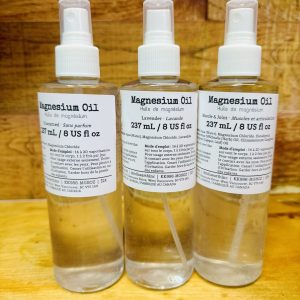
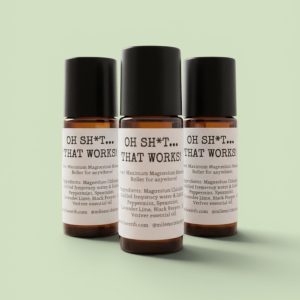
My search led me through sleep, melatonin and, finally, magnesium. When I found magnesium (first through supplements and food, then through my skin, my baths and my daily rituals), the headaches, the cramps, the restlessness and that constant feeling of stress melted away. When I stopped, they came back. For me, magnesium saved my life.
Kai
My husband Kai has always been a health nut, and he was always searching for where he belonged. He faced serious health problems of his own while we lived in Asia, and through Chinese medicine, acupuncture and a return to whole foods, he healed most of what ailed him. What we found in each other was a partner who would support the other’s journey. I may have been the driving force behind Mila Earth, but I had a man beside me who wanted healing and connection with the land and his people as much as I did.
Together we keep going back to the roots: how did our ancestors heal and recover? How did they eat? They honoured every part of the animal, gave back to the ground that fed them, felt the connection beneath their feet, and let the sun and the stars guide them at night.
Why Mila Earth exists
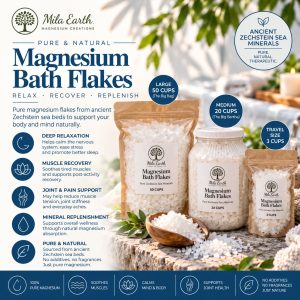
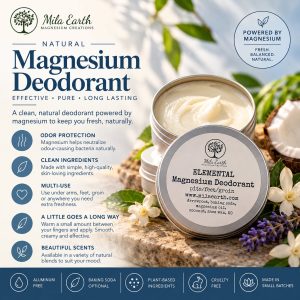
Every time I read a label and couldn’t believe what was in it, or what it cost, I went home and made my own. Twenty years later, that’s still how we work. Mila Earth is an Indigenous-owned family business: everything is handmade in small batches in West Vancouver, and our kids help make the bath flakes. We believe good, honest body care shouldn’t cost hundreds of dollars. It should be made with nature, time and care, not trends.
If you take one thing from my story, let it be this: there’s nothing wrong with you. You are perfect as you are. Something may just be missing.
Katerina
This is my personal story and experience, not medical advice. Please talk to your healthcare provider about your own health.