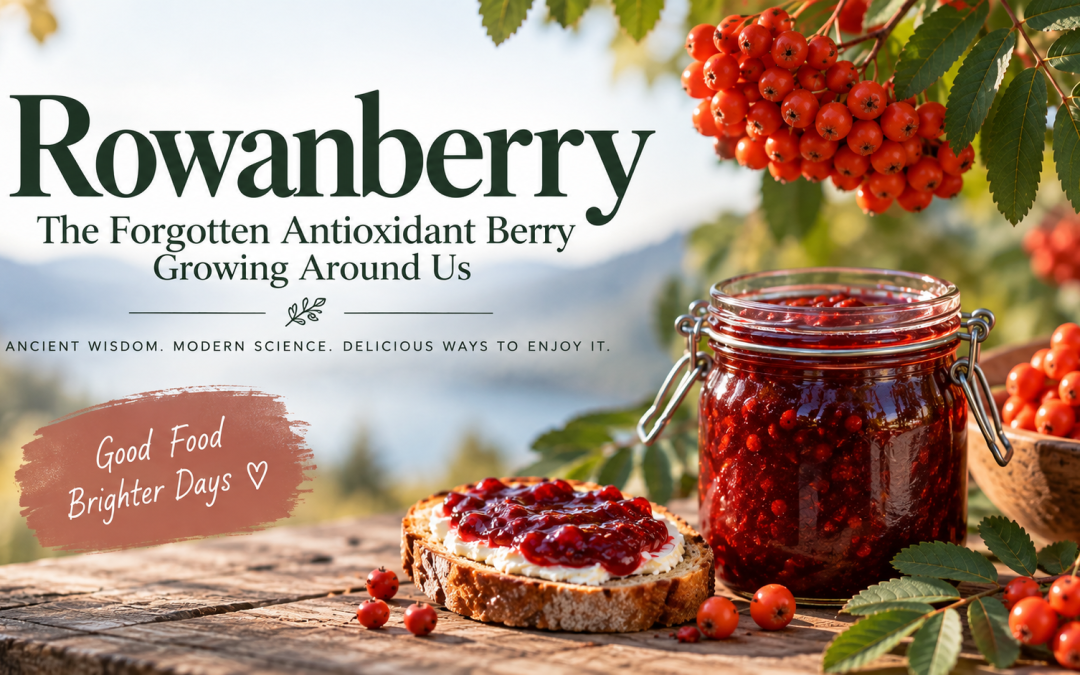
Sorbus aucuparia — Rowan / Mountain Ash
We love a superfood with a good marketing department.
Açaí. Goji. Maqui. Schisandra.
Put a berry into beautiful packaging, ship it halfway around the world, sprinkle words like antioxidant, adaptogen and longevity across the label, and suddenly we’re paying attention.
Meanwhile, there may be a tree absolutely loaded with brilliant red-orange fruit growing down the street.
That is what sent me down this particular rabbit hole.
I was watching a documentary that talked about Schisandra chinensis, the famous berry known in traditional Chinese medicine as Wu Wei Zi — the “five-flavour fruit.”
Schisandra has developed an enormous modern following, particularly in conversations about stress, resilience, antioxidants and healthy aging.
Looking at those beautiful red berries made me think about something growing much closer to home:
Rowanberry.
They’re not the same plant. Botanically they’re completely unrelated.
But it made me wonder:
What is actually inside our rowanberry?
Not what somebody says it cures.
Not whether we can turn it into another miracle “anti-aging” supplement.
Just:
What compounds does this little wild fruit actually contain?
Because sometimes simply understanding the chemistry of a plant is enough to make us look at it completely differently.
Meet Rowan
Rowan, commonly called mountain ash, is Sorbus aucuparia.
Those gorgeous clusters of orange-red fruits aren’t technically berries at all.
They’re tiny pomes, making them botanically closer to apples and pears.
And underneath that beautiful skin is a surprisingly complicated phytochemical library.
Researchers investigating Sorbus fruits have identified dozens of individual phenolic constituents.
Among compounds reported in rowan and studied Sorbus material are:
Phenolic acids and related compounds
Chlorogenic acid
Neochlorogenic acid
Caffeic acid
Ferulic acid
p-Coumaric acid
Protocatechuic acid
p-Hydroxybenzoic acid
Ellagic acid
Flavonoids
Quercetin
Rutin
Isoquercitrin
Hyperoside
Kaempferol
Isorhamnetin
Luteolin
Flavan-3-ols and proanthocyanidins
Catechins
Proanthocyanidin oligomers
Proanthocyanidin polymers
Rowan also contains anthocyanin pigments, including cyanidin derivatives, along with vitamin C, tocopherols and carotenoid pigments.
That’s quite a résumé for a fruit most of us walk straight past.
Okay, But Why Are These Compounds Interesting?
Reading a list of phytochemicals is one thing.
Understanding why scientists are interested in them is where things get fascinating.
Rowanberry doesn’t contain one magical “anti-aging ingredient.”
It contains a matrix of plant compounds, several of which are independently being investigated in areas connected with oxidative stress, inflammation, metabolism, vascular health and cellular aging.
Let’s translate some of that chemistry into normal language.
QUERCETIN — Cellular Aging + Inflammation
Quercetin is probably one of the most recognizable compounds on our list.
It’s a flavonoid also found in onions, apples, capers and numerous berries.
Researchers study quercetin for its antioxidant and anti-inflammatory properties and its interactions with cellular signalling and mitochondrial biology.
Then there’s something particularly interesting happening in longevity research:
Senescent cells.
As we age, some cells stop dividing normally but don’t disappear. These are known as senescent cells.
Researchers are investigating compounds called senolytics, which may influence these cells.
Quercetin has been investigated experimentally—particularly in combination with other compounds—in this emerging area of aging biology.
Does that mean eating rowanberry removes senescent cells?
No.
We absolutely don’t have evidence to make that leap.
But when you hear people discussing quercetin in longevity circles, this is part of the reason why.
And rowan happens to naturally contain quercetin compounds.
Interesting.
CHLOROGENIC + NEOCHLOROGENIC ACIDS — Metabolism + Oxidative Stress
These really caught my attention.
Chlorogenic acid and neochlorogenic acid belong to a family called caffeoylquinic acids, which can represent a substantial portion of the measured phenolics in Sorbus fruits.
Researchers investigate chlorogenic acids in connection with:
glucose metabolism
insulin signalling
oxidative stress
inflammatory pathways
cardiovascular health
metabolic health
This becomes particularly interesting as we get older because glucose regulation, insulin sensitivity and body composition can change substantially through midlife.
Again:
We’re talking about research surrounding these compounds.
We’re not claiming rowanberry treats metabolic disease.
RUTIN — Vascular Health
Rutin is closely related to quercetin.
It’s studied for its antioxidant properties and interactions with vascular and endothelial biology—essentially, the health and function of our blood vessels.
And vascular health isn’t some isolated issue.
Our blood vessels supply virtually everything.
Brain.
Heart.
Muscles.
Skin.
Organs.
So when we talk about longevity, maintaining healthy vascular function is part of the much larger picture.
CATECHINS + PROANTHOCYANIDINS — Plant Protection
You’ve probably already heard of catechins because they’re famously associated with green tea.
Proanthocyanidins are another fascinating group of polyphenols found in foods including:
cranberries
grapes
cocoa
apples
and various berries.
They’re investigated for their antioxidant, inflammatory and vascular effects.
Rowan gives us another source.
ANTHOCYANINS — Colour Is Chemistry
Those gorgeous reds, purples and blues in plants aren’t simply there to make our fruit bowl beautiful.
They’re chemistry.
Anthocyanins are plant pigments with biological activity and are extensively investigated in relation to:
oxidative stress
vascular function
glucose metabolism
inflammation
brain health
One of my favourite lessons in nutrition is incredibly simple:
Colour is information.
When we’re eating deeply coloured plants, we’re consuming some of the chemistry those plants created to survive and interact with their own environment.
And Then There Are AGEs
This one deserves its own little rabbit hole.
AGEs — Advanced Glycation End Products — form through reactions involving sugars with proteins or fats.
Their accumulation is extensively studied in relation to aging, metabolic health and tissue function.
Laboratory research involving Sorbus aucuparia extracts has investigated inhibition of AGE formation as well as protection against experimentally induced oxidative and nitrative damage.
Does this prove that eating rowanberry jam prevents aging?
No.
But it gives us another reason to look at this fruit and say:
Huh. That’s interesting.
Sometimes that’s enough.
What About Stress, Sleep and Menopause?
This is where I think we need to be both curious and careful.
Remember the plant that started this entire rabbit hole?
Schisandra.
Schisandra has a long history of traditional use as a tonic and today is frequently discussed in relation to stress resilience and adaptogenic activity.
Rowanberry is not our local version of schisandra.
They’re completely different plants with different chemistry.
However, several compounds naturally present in rowan—including quercetin, chlorogenic acids, flavonoids and anthocyanins—are being independently investigated in areas involving oxidative stress, inflammation, metabolism and cellular signalling.
And those areas become particularly interesting during perimenopause and menopause.
Why?
Because changing estrogen levels can influence things including:
sleep
body composition
insulin sensitivity
vascular function
inflammatory signalling
temperature regulation
mood
stress response
Does that make rowanberry a menopause treatment?
No. I wouldn’t call it a “menopause herb.”
And we don’t have evidence that eating rowanberry treats hot flashes or insomnia.
But here’s a question I find much more interesting:
Could regularly eating a wide diversity of polyphenol-rich plants be one small part of supporting healthy aging through midlife?
That is a very different conversation.
What About Sleep and Stress?
I wouldn’t tell you:
“Eat rowanberry and you’ll sleep better.”
We don’t have the evidence for that.
But sleep, glucose regulation, stress response, inflammation, vascular function, gut health and aging aren’t isolated little boxes.
They’re interconnected systems.
Researchers are increasingly interested in how dietary polyphenols interact with metabolism, inflammatory signalling, the gut microbiome and nervous-system biology.
Maybe the interesting thing isn’t discovering one berry that “makes you sleep.”
Maybe it’s remembering to feed our bodies an extraordinary diversity of plants.
That’s a different philosophy from:
Take this pill for this symptom.
It’s closer to:
Feed the system.
Don’t Forget the Rest of the Rowan Tree
Here’s another fascinating part.
The fruit isn’t necessarily the most phenolic-rich portion of rowan.
Researchers have also examined Sorbus aucuparia leaves and flowers/inflorescences, with some analyses finding particularly high concentrations of phenolic compounds in the inflorescences.
That’s another rabbit hole for another day.
But it reminds us of something traditional herbalism understood intuitively.
A plant isn’t necessarily one ingredient.
Flower.
Leaf.
Fruit.
Season.
Preparation.
Modern science tends to ask:
“Which molecule is responsible?”
Traditional food and herbal cultures often asked:
“How do we use this plant?”
Maybe there’s value in asking both.
Okay… How Do We Actually Eat Rowanberries?
This is where herbalism sometimes loses people.
We can spend an hour talking about quercetin and chlorogenic acid and then stand underneath the tree thinking:
Okay. Now what?
Here’s what I actually do.
The Rowanberry Freezer Trick
Fresh rowanberries can be incredibly tart, bitter and astringent.
Traditionally, they were often harvested after frost.
I cheat.
I use my freezer.
Pick correctly identified ripe rowanberries.
Remove the stems.
Wash them.
Then put them into the freezer.
Overnight is fine.
The freezing mimics frost exposure and helps soften some of that intensely bitter, tart and astringent character.
Then I cook them.
And that part matters.
Raw Sorbus aucuparia contains parasorbic acid, which can cause gastrointestinal irritation. Heat processing helps break it down.
My ridiculously simple rule is:
IDENTIFY → PICK → FREEZE → COOK
And now we make something delicious.
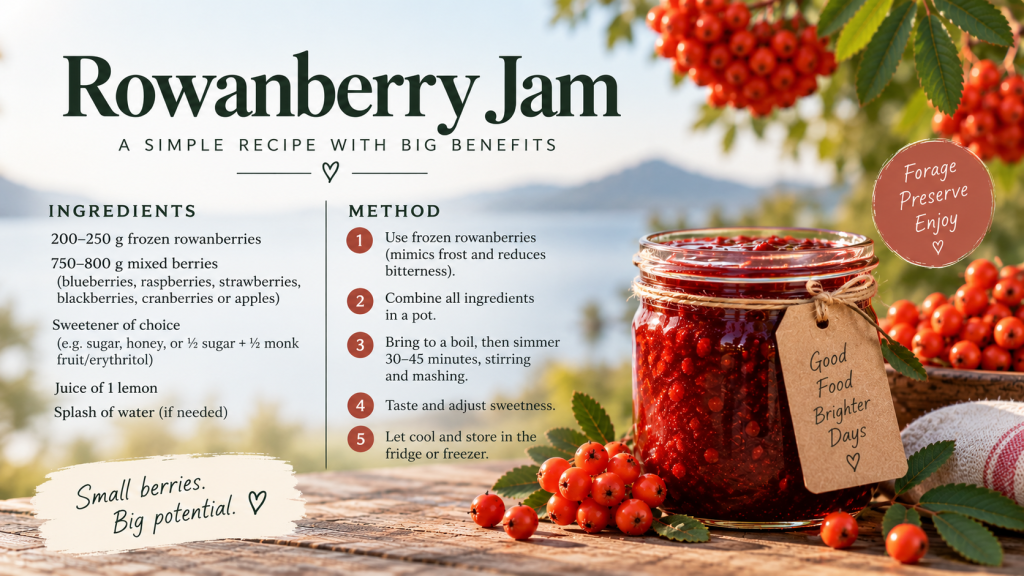
🍓 RECIPE CARD: MY EASY 20–25% ROWANBERRY JAM
Don’t make the entire jam out of rowanberry.
That’s my first piece of advice.
Rowan is powerful in flavour.
Instead, I use it almost as a wild-food addition to a mixed berry jam.
THE BASIC FORMULA
For approximately 1 kg of fruit:
200–250 g previously frozen rowanberries
plus
750–800 g other fruit or berries
That’s roughly:
20–25% ROWAN
75–80% OTHER FRUIT
My favourite combinations include:
Rowan + blackberry
Rowan + blueberry
Rowan + raspberry
Rowan + strawberry
Rowan + cranberry
Rowan + apple
Or do what I often do:
Open the freezer and see what’s there.
Blueberries, strawberries and raspberries are especially useful because they soften rowan’s intense tartness.
SWEETENER
Now you’re probably going to want some sweetness.
How you do that is completely up to you and where you are in your own food journey.
You can use:
regular sugar
coconut sugar
honey
monk fruit
erythritol
or a combination
My trick when I’m making it for the kids
I often take the middle road.
For the sweetener portion, I’ll use roughly:
½ regular sugar
and
½ erythritol blended with monk fruit
Why?
The regular sugar helps give me that familiar jammy texture and set.
The erythritol/monk fruit gives me additional sweetness without requiring the same amount of added sugar.
The berries themselves still contain naturally occurring sugars, so this isn’t a sugar-free or “zero blood-sugar” food.
It’s simply how I personally reduce the amount of added sugar while keeping the taste and texture my kids actually enjoy.
If you’d rather use honey?
Use honey.
Coconut sugar?
Absolutely.
Your grandmother’s traditional jam recipe with regular sugar?
That’s okay too.
It doesn’t have to be perfect. It has to work for your family.
YOU’LL ALSO NEED
Juice of 1 lemon
A small splash of water, only if necessary to get everything started
HOW TO MAKE IT
Place your previously frozen rowanberries and other fruit into a saucepan.
Add your chosen sweetener, lemon juice and a small splash of water if necessary.
Bring everything to a boil.
Reduce the heat and gently simmer for approximately 30–45 minutes, stirring and mashing the fruit as it cooks.
You want the rowanberries thoroughly cooked and completely softened.
Then taste.
Too tart?
Add sweetness.
Too thick?
Add a tiny splash of water.
Too thin?
Keep simmering.
Rowan naturally contains pectin, which makes it particularly well suited to preserves.
And that’s it.
You’ve made rowanberry jam.
STORAGE
If you’re experienced with preserving and have an appropriate tested canning recipe, you can safely process your preserves for shelf storage.
But if canning makes you nervous?
Use your freezer.
We’re not making life complicated here.
Allow your cooked jam to cool.
Put it into clean freezer-safe jars or containers.
Keep what you’re currently eating in the refrigerator and freeze the rest.
Reduced-sugar jam isn’t automatically shelf stable simply because it’s called jam, so freezing is an incredibly easy solution.
Stop Thinking of Jam as Something You Put on Toast
Yes.
Put it on bread.
But don’t stop there.
Take a spoonful of your rowanberry jam.
Put it into a mug.
Add hot water.
Stir.
Instant winter berry tea.
Add:
ginger
lemon
cinnamon
honey
Or spoon the jam over yogurt.
Add it to oatmeal.
Serve it alongside cheese.
Use it with meat.
Turn it into salad dressing.
Stir it into sparkling water.
Suddenly that jar isn’t merely jam.
It’s a way of carrying the autumn harvest into winter.
And having preserves that you made yourself means you can reach into your freezer in February and still access that incredible mixture of berries you harvested months earlier.
That’s practical herbalism.
🍷 RECIPE CARD: ROWANBERRY + HONEY CORDIAL
Then there’s my grown-up version.
Rowan’s naturally bitter, tart and complex flavour lends itself beautifully to a botanical cordial.
YOU’LL NEED
2 cups previously frozen rowanberries
½–¾ cup honey
500–600 mL vodka or gin
OPTIONAL
Orange peel
Lemon peel
Ginger
Cinnamon
Juniper
I particularly love:
ROWAN + GIN + HONEY + ORANGE
Put everything into a clean 1-litre jar.
Close the jar.
Shake it.
Store it somewhere cool and dark for approximately 6–8 weeks, giving it a shake occasionally.
Strain very thoroughly without crushing the seeds.
Bottle the liquid.
Taste.
If you’d like it sweeter, add a little more honey.
What you’ve made is somewhere between a botanical cordial, liqueur and traditional after-dinner digestif.
Enjoy a small amount after dinner.
Or try:
Rowan cordial + sparkling water + orange + ice.
It’s almost like a wild West Coast Aperol-style spritz.
Remember that alcohol extracts and preserves—it doesn’t cook the fruit. Rowan seeds contain cyanogenic compounds, so don’t crush or grind the seeds into your preparations. Think of this as a traditional culinary infusion rather than a treatment for any medical condition.
Why I Make the Jam
Now we can come full circle.
I’m not making rowanberry jam because I believe one spoonful is going to reverse aging.
I’m making it because I’ve taken a seasonal wild food containing:
Chlorogenic acid
Neochlorogenic acid
Quercetin compounds
Rutin
Catechins
Proanthocyanidins
Anthocyanins
Vitamin C
Tocopherols
Carotenoid pigments
…and combined it with blueberries, raspberries, strawberries, cranberries or blackberries that bring along their own phytochemical libraries.
Then I preserve it.
And when everything outside is dormant in the middle of winter, I can pull out that jar and put a spoonful into hot water.
No exotic powder required.
No fancy supplement bottle.
Just food.
Carrying Autumn Into Winter
This is the part of herbalism I don’t want us to lose.
For generations, people had to figure out how to take something abundant for three weeks and still have access to it three months later.
So we:
dried
fermented
preserved
infused
made syrups
made jams
made cordials
made teas
Today we have analytical chemistry that gives us extraordinary words:
Chlorogenic acid.
Quercetin.
Catechins.
Proanthocyanidins.
Anthocyanins.
Our ancestors didn’t necessarily have those names.
They simply knew which plants were worth gathering.
Today, we get to have both.
Ancestral knowledge + modern chemistry.
And that is where things get really interesting.
Maybe the next great “superfood” isn’t waiting for us somewhere exotic.
Maybe it’s a plant we’ve simply forgotten how to use.
IMPORTANT FORAGING + SAFETY NOTE
Always positively identify wild plants before consuming them.
This article specifically discusses Sorbus aucuparia. Don’t identify edible plants based only on berry colour or photographs.
Rowan fruit is generally processed rather than eaten in quantity raw. Cooking is an important part of the jam preparation described here because raw rowan contains parasorbic acid.
Reduced-sugar preserves should be refrigerated or frozen unless you’re following a tested canning recipe specifically designed for shelf-stable preservation.
Alcoholic preparations are for adults and should be consumed responsibly.
This article explores traditional food preparation, foraging and plant chemistry for educational purposes. It isn’t intended to diagnose, prevent or treat disease.
Related Reading
- The Egg Float Test: How to Check Egg Freshness and Why Pasture-Raised Eggs Last Longer
- The $27 Bathroom Hack That Improves Sleep (Without Taking Phones Away)
- Mulled Winter Drinks